Showing posts with label Classwork. Show all posts

Sunday, May 29, 2011

"What I know now that I didn't know in September"

Required entry. Can't make the fonts work. 
Entry follows....


I like blogging. I like being able to post pictures of what I’ve been doing, since my work lends itself so well to photography. I type faster than I write and I like being able to ramble on at great length and really say what I mean. (Not mutually exclusive, contrary to popular belief.) I particularly like it when people tell me that they read my blog and they think it’s terribly clever. Keep it up, devoted admirers. 
I have learned, and this is a big one, to ask people for help. I have all these horrible back problems that we needn’t go into, and I knew I wanted to dig a whacking great hole in my backyard, and that that would involve maneuvering pickaxes, slinging large stones, and pain and suffering in general. So I asked my large and well-muscled guy friends, and some girlfriends as well, to basically do it for me, and to my surprise they all said they would like nothing better. And I didn’t lift a finger. 
Also, I was worried about money, and I almost went without some things that I needed because I assumed they would cost so much that I shouldn’t even call, e.g. getting a load of sawdust from Cayuga Lumber and getting the Kulp Lobby space for our show. But on the off chance that we might be able to work something out I called these people up anyway, and what do you know, it was all free. So I would say don’t write off something you want before you’ve given it a try. 
Enfin, I say, things are possible. Things you wouldn’t think are possible, are eminently possible. The most important thing I can say to any future WISE student is don’t limit yourself; don’t shirk the big projects, don’t think “such and such would be so cool but I couldn’t do it because of x y or z”. X y and z are crap. Obstacles can be got round. Do the greatest thing you can think of, something you want to do because you love it. Start larger than life because you can always trim later, but if you do something you know will be easy at the outset it’s hard to make it anything but boring.

Wednesday, March 23, 2011

Happiness Revisited

Here you find my responses to the questions which go with the article with the above name.

1. When do you feel most happy?
This is very easy to answer. Contrary to popular belief, I am a happy person. Some people who know me think I am a frigid bitch who doesn't know the meaning of the word happiness, but this is because I am really only happy when I am by myself, and no one else is around (with a very few exceptions according to mood). Within that, my best place is, hands down, at the rink, on the ice. That endorphin high is like the nectar of the gods. I'm also pretty happy when I'm creating things, e.g. ceramic eggs. I am addicted to closure and I love finished products. In baking, drawing, pottery, origami, gardening - all the down-home crafts that I enjoy, being a crafty person - my favorite time is when all the ingredients have been put away and the work space cleaned and all that's left is the final product, the cake or vase or drawing or crane or flower bed or whatever, looking as though it sprang spontaneously into being. Seeing that makes me truly content.

Also, lying on beaches or tramping through rainforests works pretty well. Probably the happiest I ever was in my life was when I was in the place I showed you in my first-ever entry.

2. React/respond to the article.
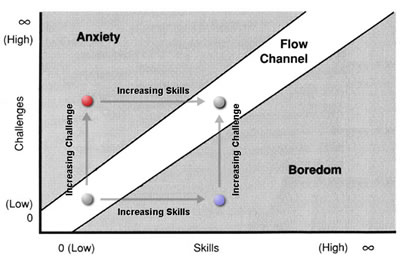
I believe that it is true that, as the author says, "optimal experience" is something that we cause to happen. We do things because we believe that they will make us happy. Even things we do that don't bring immediate happiness, like eating spinach, we do because we believe, if subconsciously, that they will make us happy in the long run. I also wholeheartedly believe in the concept of flow, as laid down in the diagram below. I am partly amused and partly appalled that it took an army of philosophers many centuries to discover its existence, but that is nothing new.

3. Where are you on the flow chart? (Below.)
I am in flow, at least for the moment. This year I have generally been pretty high up in the flow channel. I have skills and I have challenges. When I overstep the bounds of the flow channel, it is almost always in the anxiety direction, where my challenges exceed my skills. But this passes. 

4. How has this changed/remained the same throughout your project?
I chose, if I say it myself, a near-perfect project for me, one pretty much guaranteed to keep me in flow. I have challenged myself more than in any of my previous efforts in the studio, and found that my skills were up to the task.

5. How can you achieve flow?
I have achieved it. Had I not, I would say, by periodically introducing new challenges into one's life, and taking the time to master the skills required to confront said challenges before introducing new challenges.

Sunday, March 20, 2011

Response to Hannah Amsili's WISE Journal

It appears we have to do this entry for class, ho hum. I am going to evaluate the journal of a past WISE student based on several criteria, and this is the last entry I need to be completely caught up, so I'm going to waste no time. (FYI the WISE student is Hannah Amsili, and her project is a mosaic.)

First, the physical journal: Hannah's journal is paper, because she was in WISE in '05, and the blogosphere was only a fetus of the Internet at that time. Her entries are uniformly dated, and also titled. No complaint here. She even incorporates pictures, printed out and cut and pasted in - how quaint. She is clearly excited about her project, though she has a different way of showing it than I do. Her journal is replete with exclamation points, cute puns, and capital letters.

Hannah's handwriting is bad, but so is mine, and it's only sheer chance that you're not suffering through a journal of my handwriting at the moment. What surprises me more is that her entries are brief; I think I've already written more, word for word, than there is in her entire journal. This is not necessarily good nor bad. I'm typing, and I type fast, and there's a lot of room for extraneous words and thoughts and information. I can type in a sort of stream of consciousness, whereas if I was writing by hand, I might have to think more before I wrote. Which could be good, or I could lose the brilliance I have (heh) if it took me too long to get it down.

The nicest thing about reading this journal was that I got to see how Hannah's project evolved, and how her finished product wasn't exactly has she had envisioned at the start. My project, as you who have been dutifully following my progress are no doubt aware, has changed not a little since I laid down my first plan. Hannah's changed as well; from the location of her mural to smaller details like what grout to use on the backing, she made adjustments and made them well. Her finished product is a job well done. It gives me hope.


Tuesday, March 15, 2011

Reactions to "Two Tramps in Mud Time" and "Practicing"

We all have to complete this assignment, akin to a first-semester journal entry, detailing our reactions to two readings. One is a poem by Robert Frost, whom I greatly admire, and one is a random piece of Internet detritus which breaks off abruptly in the middle of a sentence. They both deal with work, which I imagine is why we have to read them, because we are all doing projects which involve work.

Profound eh? I thought so.

So: "Practicing" appears to have been written for one of the teach-yourself-to-play-guitar websites with which the Internet is so thickly packed that it is impossible to swing a virtual cat without hitting eight or nine of them. The author has a lot of deep wisdom to share about pushing oneself outside of one's comfort zone if one wants to improve at whatever one is working on. I don't really scoff at this. It seems obvious enough, but when I look at my life I see that it really is an easy thing to forget. It's odd, when everything about our world and our species is driven by change, that individuals instinctually don't want any part in advancing that change on a small scale. With a few exceptions, we don't like practice; we want immediate gratification - the final product now, without any of the work. But without the work, the final product cannot exist. So we force ourselves to practice whatever it is we're doing - in my particular case, the skills involved in wheel-throwing - and we are better for it.

I agree with the article's message as a whole, and I think it is sad but true that we need constant reminding to step outside our comfort zones or we won't do it. One thing the article says, though, I do not understand at all: "I can't tell you how many times I've practiced a particular lick or technique for an hour straight with minimal improvement that day, but the next day almost as soon as I tried it, it seemed to flow more easily." I wish I had ever felt this. Ceramics is a crapshoot, if you will - I have good days and bad days at the wheel, days where I can make anything I want and days when the clay seems to hate me and ends up as a useless lump. In my other life as an athlete, this is true as well. So maybe if I want to experience what the author of this article is describing, I need more practice.

Now I come to "Two Tramps in Mud Time". I very much enjoyed this poem, which is written in Robert Frost's characteristic simple, sweet style. But I think I am supposed to be relating these reading to my project, so I won't spend time quoting lines I like, but go straight to responding to the passage I am sure Ms. Gergely had in mind for us:

   But yield who will to their separation
   My object in living is to unite
   My avocation and my vocation
   As my two eyes make one in sight.

Oh, how nice that sounds, to be able to do what you love as your job, and not relegate it to the realm of "hobby", only to be dragged out of the closet on alternate Sundays. I wish it applied to me. But unfortunately, the things I love best are things that would make me no money at all. Ceramics is a solid example. In truth, that's most of the reason why I took WISE, so I could devote a whole semester to my avocation before going off to college and studying for a vocation which must, for me, be different.